Siem Reap is one of Cambodia’s most popular tourist destinations, thanks to the world-famous Angkor Archeological Park. The name Siem Reap is from the local Khmer dialect and means “defeat of Siam.” The name is said to have been given to the city by King Ang Chan.
Before its rise to prominence, Siem Reap was a little known quiet village in Cambodia. In the turn of the 20th century, an expedition into the nearing forest would change the fate of this quiet region forever. About the same time, Angkor was rediscovered, thrusting Siem Reap into the limelight as archeologists and tourists gained interest in the previously little-known haven. The village thrived and bloomed into the current stunning city.
Today, Siem Reap boasts world-famous accommodation which ranges from luxury hotels to budget hotels and restaurants. There are dozens of eateries and clubs lining the streets of the city, all ready to host tourists eager to explore the ancient ruins of Angkor. The temples at Angkor Archeological Park never cease to impress, which is why this park is truly one of Southeast Asia’s most remarkable places.
Siem Reap I must say isn’t exactly that touristy, despite the fact that there’s a fair amount of foreigners when we were there. Prices are quoted in USD most of the time, and they are sold at competitive rates (despite conversion to MYR).
Our direct flight to Siem Reap happened to be the first flight of the day (17th June 2018). After flying for 2-hours, we arrived, bleary-eyed, at the Siem Reap International Airport. For an airport in a third world country, it’s extremely modern and well-organised :) it seemed pretty bare though; there was just one other plane parked.
Once reached at Siem Reap airport we were greeted by our tour agent (Pros), he bring us to place called Angkor Ticket Center to buy ticket based on the day we plan to visit the temple.To give you an idea of how long that is, most people spend around 3-4 days in Siem Reap to see Angkor Wat.
Below are the rates:
- 1 day at US$ 37 per person
- 3 days at US$ 62 per person
- 7 days at US$ 72 per person
Angkor Ticket Center

Day 1 Activities:
Pre Rup
Pre Rup is a Hindu temple at Angkor, Cambodia, built as the state temple of Khmer king Rajendravarman and dedicated in 961 or early 962. It is a temple mountain of combined brick, laterite and sandstone construction.The temple’s name is a comparatively modern one meaning "turn the body". This reflects the common belief among Cambodians that funerals were conducted at the temple, with the ashes of the body being ritually rotated in different directions as the service progressed.


East Mebon
The East Mebon is a 10th Century temple at Angkor, Cambodia. Built during the reign of King Rajendravarman, it stands on what was an artificial island at the center of the now dry East Baray reservoir.The East Mebon was dedicated to the Hindu god Shiva and honors the parents of the king. Its location reflects Khmer architects’ concern with orientation and cardinal directions. The temple was built on a north–south axis with Rajendravarman’s state temple, Pre Rup, located about 1,200 meters to the south just outside the baray. The East Mebon also lies on an east–west axis with the palace temple Phimeanakas, another creation of Rajendravarman’s reign, located about 6,800 meters due west.


Ta Som
Ta Som is a small temple at Angkor, Cambodia, built at the end of the 12th century for King Jayavarman VII. It is located north east of Angkor Thom and just east of Neak Pean. The King dedicated the temple to his father Dharanindravarman II (Paramanishkalapada) who was King of the Khmer Empire from 1150 to 1160. The temple consists of a single shrine located on one level and surrounded by enclosure laterite walls. Like the nearby Preah Khan and Ta Prohm the temple was left largely unrestored, with numerous trees and other vegetation growing among the ruins.


 Neak Pean
Neak Pean (or Neak Poan)("The entwined serpents") at Angkor, Cambodia is an artificial island with a Buddhist temple on a circular island in Jayatataka Baray, which was associated with Preah Khan temple, built during the reign of King Jayavarman VII.It is the "Mebon" of the Preah Khan baray (the "Jayatataka" of the inscription).


Traditional Music
Preah Khan ("Royal Sword") is a temple at Angkor, Cambodia, built in the 12th century for King Jayavarman VII to honor his father.It is located northeast of Angkor Thom and just west of the Jayatataka baray, with which it was associated. It was the centre of a substantial organisation, with almost 100,000 officials and servants. The temple is flat in design, with a basic plan of successive rectangular galleries around a Buddhist sanctuary complicated by Hindu satellite temples and numerous later additions. Like the nearby Ta Prohm, Preah Khan has been left largely unrestored, with numerous trees and other vegetation growing among the ruins.
At a temple called Phnom Bakheng (a short distance from the Angkor temple), and this place has been famous for a while now as the spot for sunset watching.
Angkor Temple view from Phnom Bakheng


 Day 2 Activities:
Banthey Samre
Day 2 Activities:
Banthey Samre
Banteay Samré is a temple at Angkor, Cambodia, located 400 metres to the east of the East Baray.Built during the reign of Suryavarman II and Yasovarman II in the early 12th century, it is a Hindu temple in the Angkor Wat style.Named after the Samré, an ancient people of Indochina, the temple uses the same materials as the Banteay Srei.
Banteay Samré was excellently restored by Maurice Glaize from 1936 until 1944.The design of its single ogival tower is immediately recognizable as Angkor Wat style along with other temples in the region such as Thommanon and Chau Say Tevoda. Due to this temple looks familiar with a few monuments of north-east Thailand, it has very much appearance of a compacted Phimai. While there are no inscription describing about its foundation, it seems likely to be built by a high official of the court during the reign of King Suryavarman II.
Banteay Srei Temple ( The Citadel of the Woman )
Banteay Srei or Banteay Srey is a 10th-century Cambodian temple dedicated to the Hindu god Shiva. Located in the area of Angkor, it lies near the hill of Phnom Dei, 25 km (16 mins) north-east of the main group of temples that once belonged to the medieval capitals of Yasodharapura and Angkor Thom.Banteay Srei is built largely of red sandstone, a medium that lends itself to the elaborate decorative wall carvings which are still observable today. The buildings themselves are miniature in scale, unusually so when measured by the standards of Angkorian construction. These factors have made the temple extremely popular with tourists, and have led to its being widely praised as a "precious gem", or the "jewel of Khmer art."


Kbal Spean Resort ( A river of 1000 linga's )
Kbal Spean("Bridge Head") is an Angkorian era archaeological site on the southwest slopes of the Kulen Hills to the northeast of Angkor in Siem Reap District, Siem Reap Province, Cambodia. It is situated along a 150m stretch of the Stung Kbal Spean River, 25 kilometres (16 mins) from the main Angkor group of monuments, which lie downstream.
The site consists of a series of stone rock relief carvings in sandstone formations of the river bed and banks. It is commonly known as the "Valley of a 1000 Lingas" or "The River of a Thousand Lingas". The motifs for stone carvings are mainly myriads of lingams (phallic symbol of Hindu god Shiva), depicted as neatly arranged bumps that cover the surface of a sandstone bed rock, and lingam-yoni designs. There are also various Hindu mythological motifs, including depictions of the gods Shiva, Vishnu, Brahma, Lakshmi, Rama, and Hanuman, as well as animals (cows and frogs).
The journey to Kbal Spean takes about 45 minutes from the city centre. The best way to get there would be to hire a cab or book a car the previous day. Taking a tuk tuk might be more of a bumpy and time-consuming ride. You could club the trip with a visit to Banteay Srei.
Some of the figures and depictions to look out for:
- Lord Brahma sitting on a lotus
- Reclining carving of Lord Vishnu on the serpent God Ananta
- Animal motifs including bulls
- A river bed full of small Shiv lingas
- Gods etched on the inner bed of the pool above
You will enjoy the hike if you take it slow and look around. On reaching the top of the hill, do not confine yourselves to the central spot. Venture further up, take detours both to the left and right and find the path dipping slightly to a hollow valley of butterflies and dried leaves (during summers) or waterfall(during the rainy season). There are enough points to stop and rest under sheds and shelters. Carry your own bottle of water and snacks if needed, as there are no shops or eateries up there. Additionally, if you want a detailed explanation on each of the motifs and figurines and the exact path to traverse, you could hire a guide as well.For me and my wife dont hike without giude, we walk follow the path
Kbal Spean at Kullen Hills, is an archaeological site that houses one thousand lingas and figurines by the Stung Kbal Spean River, thus, also known as the Valley of Thousand Lingas. The river is believed to branch out as a tributary of the Siem Reap River. Gods, animal figures and other Hindu mythological characters have been beautifully carved along the river bed. You need to venture out to both the sides atop the hill, for different views.
Carved right at the river bed, these sandstone structures speak a lot of the belief and religion back in time. They date back to the 11th and 12th centuries, believed to have begun during the rule of King Suryavarman I and ended during that of King Udayadityavarman II. It took quite some time to discover this ignored site, and its doors finally opened to visitors in 1989.

I
Beng Mealea
Beng Mealea or Bung Mealea its name means "lotus pond" is a temple in the Angkor Wat period located 40 km east of the main group of temples at Angkor, Cambodia, on the ancient royal highway to Preah Khan Kompong Svay.A spectacular sight to behold, Beng Mealea, located about 68km northeast of Siem Reap, is one of the most mysterious temples at Angkor, as nature has well and truly run riot. Exploring this titanic of temples, built to the same floor plan as Angkor Wat, is the ultimate Indiana Jones experience. Built in the 12th century under Suryavarman II, Beng Mealea is enclosed by a massive moat measuring 1.2km by 900m.
Day 3 Activities:
Baksei Chamkrong
Baksei Chamkrong is a small Hindu temple located in the Angkor complex (Siem Reap, Cambodia). It is dedicated to Lord Shiva and used to hold a golden image of him. The temple can be seen on the left side when entering Angkor Thom at the southern gate. It was dedicated to Yasovarman by his son, King Harshavarman I.The temple was completed by Rajendravarman II (944-968).
Bayon
The Bayon (Prasat Bayon) is a richly decorated Khmer temple at Angkor in Cambodia. Built in the late 12th or early 13th century as the state temple of the Mahayana Buddhist King Jayavarman VII,the Bayon stands at the centre of Jayavarman's capital, Angkor Thom.Following Jayavarman's death, it was modified and augmented by later Hindu and Theravada Buddhist kings in accordance with their own religious preferences.
The famous faces of the Bayon
Baphuon
The Baphuon is a temple at Angkor, Cambodia. It is located in Angkor Thom, northwest of the Bayon. Built in the mid-11th century, it is a three-tiered temple mountain built as the state temple of Udayadityavarman II dedicated to the Hindu God Shiva. It is the archetype of the Baphuon style with intricate carvings covering every available surface. The temple adjoins the southern enclosure of the royal palace and measures 120 metres east-west by 100 metres north-south at its base and stands 34 meters tall without its tower, which would have made it roughly 50 meters tall. Its appearance apparently impressed Temür Khan's late 13th century envoy Chou Ta-kuan during his visit from 1296 to 1297, who said it was 'the Tower of Bronze...a truly astonishing spectacle, with more than ten chambers at its base.'


Phimeanakas/Royal Palace area/Terrace of the elephants and Terrace of the Leper King/Tep Panama/Thommanom/Chau Say Thevoda /Ta Keo/Sras Srang/Banteay Kdei/Prasat Kravan/Ta Prohm ( Tomb Raider Movie, Angelina Jolie )
Before going there, I thought that Angkor Wat was one single temple. It turns out that whole Angkor area is huge with many temple complexes scattered all over, the main one being Angkor Wat. One would need a week or more to see them all, especially the more remote ones.
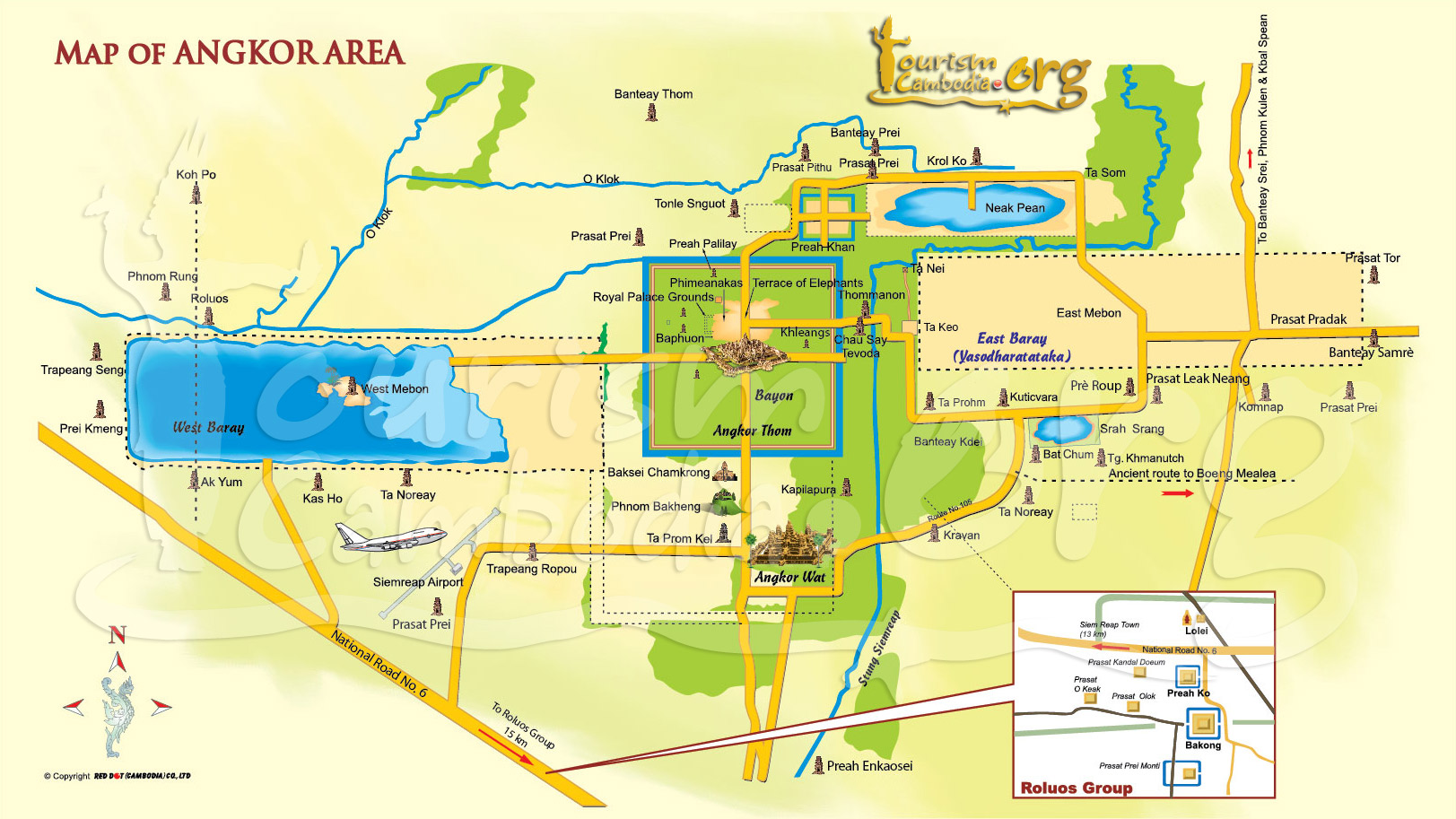
Finally it was time for the grand finale: Angkor Wat, we reached about 4.30pm and its heavy rain.We need to wait until the rain stop to continue our expedition.Angkor Wat may be on every gap year travellers hit list, but this is for a damn good reason. This Cambodian temple complex dates back to the 12th century and is the largest religious monument in the entire world!
What is Angkor Wat?
Angkor Wat("Capital Temple") is a temple complex in Cambodia and the largest religious monument in the world,on a site measuring 162.6 hectares (1,626,000 m2; 402 acres).It was originally constructed as a Hindu temple dedicated to the god Vishnu for the Khmer Empire, gradually transforming into a Buddhist temple towards the end of the 12th century.It was built by the Khmer King Suryavarman II in the early 12th century in Yaśodharapura, the capital of the Khmer Empire, as his state temple and eventual mausoleum. Breaking from the Shaiva tradition of previous kings, Angkor Wat was instead dedicated to Vishnu. As the best-preserved temple at the site, it is the only one to have remained a significant religious centre since its foundation. The temple is at the top of the high classical style of Khmer architecture. It has become a symbol of Cambodia,appearing on its national flag, and it is the country's prime attraction for visitors.
Angkor Wat combines two basic plans of Khmer temple architecture: the temple-mountain and the later galleried temple. It is designed to represent Mount Meru, home of the devas in Hindu mythology: within a moat more than 5 kilometres (3 mi) long and an outer wall 3.6 kilometres (2.2 mi) long are three rectangular galleries, each raised above the next. At the centre of the temple stands a quincunx of towers. Unlike most Angkorian temples, Angkor Wat is oriented to the west; scholars are divided as to the significance of this. The temple is admired for the grandeur and harmony of the architecture, its extensive bas-reliefs, and for the numerous devatas adorning its walls

Aerial view of Angkor Wat, showing the moat and causeway and the central tower surrounded by four smaller towers
Heavy rain before we enter Angkor Wat
Lord Vishnu Buddha
Carvings, Angkor Wat
Day 4 Activities:
Wat Preah Prom Rath
Last day before we departure, we just went to Way Preah Prom Rath just behind our hotel.Its just 5 minute of walking distance.And Wat Preah Prom Rath was certainly interesting. I breezed through the gate straight to the enterance area, where a group of young locals were quietly having a conversation.
After a quick smile and a nod at them, we walked around the site.Lying by the river, Preah Prom Rath Pagoda is adjacent to a well-embellished bridge. It was actually the bridge that caught my attention first, but my eyes wandered around the nearby places and spotted a highly ornate gate, featuring carvings of Buddha and his followers. The temple grounds are huge, hosting several buildings including the main hall (Preah Vihear building), a university building, and decorated towers scattered throughout the site. It is one of the many spiritual centers in the city proper. Some of the Buddhist monks I had encountered were friendly. While we didn’t exchange a word, they greeted me with a smile every time. It’s always nice to feel welcome at a sacred place like this.
Preah Promreath Pagoda
The main entry gate to the temple and the many towers in the area
A boat replica in front of the temple
While the many colorful towers that surround the main temple were really attractive, the most curious structure outside was the replica of a boat with a monk on it, holding a pot. I thought it was not of any significance until I stepped into the temple where a brief history of the place was written on a board.
In 1900 BE or in 1500 AD, a colossal statue of reclining Buddha was built and placed inside the main temple of Wat Preah Prohm Rath. What caused our then Buddhists to build the statue was that there was a story that in the year 1500 AD, there was a Buddhist monk who always traveled by boat to ask for food at Long Vek, the ancient capital of Cambodia, which is situated near the capital city of Phnom Penh. It is a long way from here to the ancient capital. But whenever he returned to this place from Long Vek, the rice in his pot was still fresh and so people nicknamed him Preah Ang Chong Han Hoy, which means “monk with freshly cooked rice in his pot.”
One day, while he was traveling in his boat, some sharks attacked the boat and the boat broke into two pieces. Instead of sinking into the lake, one piece of the boat floated to Wat Boribo in Kompong Chnang Province’s Boribo district. The Buddhists there built a standing statue. The other piece, the prow part, brought him back here safely. It was going with great speed that the water could not flow into it. Because of this wonderful event, our Buddhists decided to build a statue of reclining Buddha made of the wooden piece of the boat which has been kept in the Preah Vihear building. It has been subsiding deeper and deeper because the ground is growing thicker. Besides, the statue has been kept in the Preah Vihear building for over half a millennium.
Sleeping Buddha
The bas relief on the main gate
Despite the scorching heat and the large crowds, I really enjoyed my time there. It’s definitely worth visiting, and it lives up to the hype.Aside from exploring the temples, I found Siem Reap to be a very nice place to explore more hidden secret with interesting beautiful temple architecture.The hotels are very good and cheap. Same can be said about the food.


